Showing posts with label On the Philippines. Show all posts

Monday, December 3, 2012

It's More Fun in the Philippines

When  winter makes us shiver with cold, and dark clouds seem to impede us from enjoying the day,  it is always nice to think of being in a warm place surrounded by the beauty of nature and the  heartwarming smiles of the Filipinos. Specially at this time of the year with the gaiety and cheers inspired by the Christmas holiday scenes, and the monsoon season out of the way, fun is almost to be guaranteed when you are in the Philippines. Here are some interesting photos about the Philippines.


White Christmas: It's More Fun In The Philippines! (Photo from DOT NY). #travel #ttot


PHOTO: "Here comes Santa Claus.." #Manila PHILIPPINES #Christmas #travel #ttot #Asia #fun (Photo from youlaughforme.blogspot.com)


PHOTO: Fantasy World, Lemery, Batangas, PHILIPPINES #odd #travel #Asia (Photo by James Singlador)


PHOTO: Piña (Pineapple) Silk Fabric is considered the Queen of the Philippine Fabric because of its sheer delicate beauty and is the fabric of choice of the Philippine elite. The world's largest and oldest producer is Kalibo, Aklan, and it was said that the practice of weaving from pineapple silk dated back to the Pre-Hispanic period. (Photo description: Models wear evening wear made from piña fabric from Fanny Serrano's Holiday 2012 collection during the designer's fashion show at Philippine Fashion Week in May this year. Photo by Roger Nazer Lactao, Jr) #art #fashion #couture #Philippines #Asia


Art: "Fruit Pickers Harvesting Under The Mango Tree (1939)" by Philippine National Artist Fernando Amorsolo Y Cueto, a master in chiaroscuro technique in his depictions of the Philippine rural scenes. His recurring subject is about the beauty of the #Philippines, the people and history. #Asia


PHOTO: Dreaming of the weekend at Snake Island, Palawan PHILIPPINES #travel #Asia #ttot #news (Photo by John K. Chua)


PHOTO: "Kapayapaan/Peace"- Sampaloc Lake, San Pablo City, Laguna PHILIPPINES #travel #Asia #ttot (Photo by Niko Lazo) 


Photo: Alemet, Ifugao, PHILIPPINES #travel #Asia #ttot (Photo credit: IRRI)

Friday, July 20, 2012

Palawan Island Nº1 Getaway In The World


By:


The fun in the Philippines is definitely starting to pick up with a private getaway island in Palawan province taking the top spot in the British edition of Vogue Magazine’s 100 best holiday destinations in the world.

In a statement, Tourism Secretary Ramon Jimenez Jr. said Philippine tourism would surely benefit from the worldwide recognition.
“What is remarkable is that the entire resort is a testament to the unique artistry and skills of Filipino designers and artisans,” Jimenez said.

“The use of local materials and traditional techniques serves as good advertising for Filipino craftsmanship and world-class products,” he added.

The resort is owned by British property developer Charles McCulloch and his wife, Carrie.

The United Kingdom remains to be one of the Philippines’ biggest tourism markets, registering over 104,400 tourist arrivals last year, which the DOT noted was a record.

Friday, June 8, 2012

"It's More Fun in the Philippines"


On board one of London’s iconic double-deck buses, President Aquino and Tourism Secretary Ramon Jimenez Jr. lead a photo shoot promoting the “It’s More Fun in the Philippines” tourism campaign at Intercontinental London Park Lane Hotel in the British capital. The campaign was also launched via taxi cabs and subway train stations. MALACAÑANG PHOTO

The country’s new tourism slogan, “It’s more fun in the Philippines,” is gaining more positive reactions among Filipinos since its launch in January this year.

Based on the results of a tracking survey conducted by independent research firm Ipsos ASI Philippines, the overall likeability of the Philippines’ tourism slogan even improved in March at 92 percent from only 87 percent in February.

Ipsos Philippines pointed out that the initial success of the tourism campaign can be attributed to the “power” of the Internet and social networking sites such as Facebook and Twitter. The survey on the respondents in February and March this year revealed that these websites were the second main source of awareness next to television.

Source:  Philippine Inquirer 

It is wonderful to know that the Philippine government is doing a lot of propaganda to attract tourists and be able to improve the economy so that inspite of the going on crisis worldwide, the Filipinos are optimistic that the national economy will not only survive but develop and grow in the near future.

Wednesday, November 30, 2011

What It Takes To Be A Hero


Just being kind can make you a hero
By: Elizabeth Lolarga
Philippine Inquirer

As the observance of National Heroes Day approaches, high-school students from the Community of Learners in San Juan City share their thoughts on what heroism is, and how they can go about being heroes in their own small way.

David Yap writes, “Being a hero isn’t that complicated. Doing big things doesn’t make a hero, but being unusually kind and generous gets you there pretty quickly. Heroes are people who are true to themselves, yet can still put others’ needs first. Just simply picking up trash and putting them in the garbage bin or saving a weaker kid from bullies is already the mark of a hero. You don’t have to be big and buff. Nor do you need super strength. Doing simple things where you put others before yourself makes you a hero.”

Kimberly Yu agrees that a simple gesture like “telling someone his or her shoelace is untied can help a lot. Even going to work on time or taking a sick friend’s shift is heroic. Let the old lady or the little kid go first in the bathroom when you’re in a line. These are simple acts of heroism. It would be great to make a habit out of it. Such acts of helping somebody not to trip, pee in their pants or get fired from work may not mean a lot to the world, but they do for certain people.”

Franco Gargantiel writes, “Heroism isn’t all about dying for your country or fighting for freedom and basic rights. It’s also about being a role model for others and doing what’s right. Recycling paper is also significant. Heroism is an act that shows valor and chivalry. It is also found in the smallest acts.

Like his classmates, Junald de Guzman thinks “being a hero doesn’t automatically mean doing something big and being on the cover of newspapers and magazines. Heroism means doing something for someone, or something, whether it’s for a person, an animal or nature itself. A hero isn’t just someone who stops a bank robbery or saves a little boy trapped in a well. A hero is someone who does something for others, even if no one notices it.”

Today´s youth are weaning from Batman, Spider Man, the X-Men, Astro Boy and other comic superheroes, and are casting instead for real, flesh-and-blood heroes who are not imbued with superhuman powers, but with the wisdom to know that a simple act can be converted into an act of heroism. That it is in everyone's possibility to be a hero in his own way.

Saturday, November 12, 2011

The New 7 Wonders of Nature


From all around the World people have chosen the new 7 wonders of the world, including Puerto Princesa, Philippines. What a pride!

Friday, October 14, 2011

Filipinos' Attitude When Faced by Floods

Hauntingly Idyllic Inspite Flooding


By , ,
,
2:31 am Sunday, October 9th, 2011

The above journalists have gathered  stories that showed the Filipinos' attitude when faced by floods such as those caused by Typhoons "Pedring" and "Quiel" in Luzon.  According to their report:

In Ifugao, a man put together a set of plastic barrels to make a raft to ferry government employees between  Cagayan and the Cordillera region (when Pedring’s rains collapsed Burnay Bridge).

Charging passengers P10 for each trip, the man managed to earn P7,000 which helped him feed his family.

It was the same experience for Paulo Alvarez, a carpenter who rented out his wooden banca while carpentry jobs were unavailable.

“You can’t live on relief goods all the time,” said Alvarez, 47, to stress the value of self-reliance. He charges his passengers from P50 to P200, depending on the distance traveled. Alvarez said his earnings were spent stocking up on food for the household, especially rice. Worried about his children’s safety, he has been teaching them and their friends to swim.

Whereas, Fajardo said he and his family survived the week’s floods by moving to his brother’s house. They stayed on the small, unfinished second floor, where they slept on plastic chairs. “We slept in a sitting position, with our children on our laps. We looked for tarpaulin sheets and tied these to a tree to protect us from the rain,” he said.
But amid the hardship, Fajardo said, “we never thought that we would not overcome, we knew we would survive.”

There were nights with no food and they sought sleep to forget their hunger. They drank rainwater to sustain themselves. Fajardo said that when he braved the strong currents to find rice and canned goods for his family, he made sure that his relatives would have something to eat too.

Juliana Flores, 77, and 23 family members had to move out of their house in Barangay Calizon in the afternoon of Sept. 30 because they had run out of food and water.
“We were in a difficult situation, especially because our family has many children and we have an elderly family member who is sick. Our house is on high ground but the floods reached us… We had no choice but to leave so we can survive,” Flores said in Filipino.
She said they hired a boat that collected them on the terrace of their house’s second floor. They ended up in Barangay Lugam in Malolos City, where they found a family who gave them shelter for the night.

“We did not know anyone in Lugam but we knocked on a door. We pleaded that they allow us to stay for the night. We were lucky that the family was kindhearted and sheltered us, a family of 24 people, without asking for payment,” Flores said.

In Masantol, Pampanga, Marcelo Lacap Jr. refused to abandon Barangay Sagrada and seven other eastern coastal barangays because he was determined to help his neighbors—or more than 500 families.   With a report from Vincent Cabreza, Inquirer Northern Luzon

In times of need, Filipinos maintain their unsinkable spirit and struggle to survive with the help of each other.

Wednesday, August 3, 2011

Filipino Customs


The Philippines is not only known for its 7,107 islands but also for having some customs typically adherent to their culture.

Below are a few unique customs seen in most Filipino interactions depending on how 'traditional' the Filipinos are that you encounter as published by Cavi as Yahoo Contributor Network in November 6, 2007.

1. "Mano po"
"Mano po" (pronounced mah-noh poh) refers to a physical gesture of taking the hand of an elder and bringing it towards your forehead. This is a sign of respect for the elder and is usually done at the point of greeting or farewell. Children are expected to perform this gesture towards adult relatives & adult family friends. Failure to perform "mano po" would be considered as disrespectful.

2. "Kuya" or "Ate"
The Filipino culture is very big on respect. The older an individual is, the more they call for respect. The term 'kuya' (pronounced koo-yah) refers to an older male person; it means 'big brother.' Its verbal usage indicates that you respect the older male and recognize the difference in age. The feminine form is 'Ate' (pronounced ah-teh) which is directed towards an older female person; it means 'big sister.' Children are encouraged to use these terms with their older siblings. Adults can use these terms to address friends or co-workers regardless of whether or not they are truly related. It simply demonstrates a form of respect for the older individual.

3. The power of the eyebrows.
In other cultures, the eyebrows usually convey emotion via a variety of facial expressions. In Filipino culture, raising your eyebrows can also communicate a positive affirmation of "yes" when a yes/no question has been asked. So, should a Filipino fail to verbally answer your question, look at their eyebrows before feeling like you were being ignored. Without you knowing it, they may just be answering you non-verbally through the raising of their eyebrows.

Raising your eyebrows accompanied with strong eye contact can also serve as a greeting or farewell to an individual you can not physically touch.

4. The lips give direction.
Again, a non-verbal expression performed by Filipinos. By puckering their lips and facing a certain direction, they are using their lips to point to communicate a certain direction. Instead of wasting physical energy by lifting their arm/hand to point, they conserve energy by using their puckered lips.

5. Food at every gathering.
Whether it be a grand party or just an informal meeting, Filipinos express their hospitality & friendship through the serving of food. The more grandiose the cuisine, the more 'love' they are trying to convey to those at the gathering. Instead of asking, 'how are you?' Filipinos will ask, "have you eaten yet?'

6. Take your shoes off when entering a Filipino home.
By taking your shoes off when entering a Filipino home, you are conveying utmost respect towards the owners of the property. You are showing them that you care about their property and have the desire to maintain its cleanliness. More modern Filipinos who have tile or wood floors may not expect you to take your shoes off because of the coldness of the floor, however, if you do adhere this custom, then you will surely make a favorable impression.

7. Hellos and Goodbyes cannot be taken for granted.
You must greet everyone "hello" at every meeting and say "good-bye" at each farewell. For anyone present, you can either offer a 'mano po,' a kiss on the cheek, or offer eye contact coupled with raising your eyebrows to those you are unable to physically reach or those you do not know very well. Failure to offer a greeting or farewell would indicate that you are disrespectful, and a snob. So, be attentive to those present as you do not want to offend anyone.

The minimal verbiage in Filipino Culture could be best explained through a silent adherence to the common expression: "actions speak louder than words."

Source: Associated Network from Yahoo

Note on video:  A video showcasing the beauty of the remarkable places & people of the Philippines set to the music of Freddie Aguilar's "Bayan Ko", which sometimes gets mistaken as the Philippines National Anthem because of its popularity.

Here is the translation to the lyrics of this moving song.

"Bayan Ko (My Country)"

My country the Philippines
Land of gold and flowers
With love in her palms
She offers beauty and virtue.
And of her modesty and beauty
The foreigner was attracted
O, my country, you were enslaved
Mired in hardship.

Even birds that are free to fly
Cage them and they cry,
Much more a beautiful country
Shall long to be free.
Philippines my beloved,
Cradle of my tears and poverty
I'll aspire,
To see you truly free.

***Tagalog Lyrics***

Ang bayan kong Pilipinas
Lupain ng ginto't bulaklak
Pag-ibig na sa kanyang palad
Nag-alay ng ganda't dilag.
At sa kanyang yumi at ganda
Dayuhan ay nahalina
Bayan ko, binihag ka
Nasadlak sa dusa.

Ibon mang may layang lumipad
kulungin mo at umiiyak
Bayan pa kayang sakdal dilag
Ang di magnasang makaalpas!
Pilipinas kong minumutya
Pugad ng luha ko't dalita
Aking adhika,
Makita kang sakdal laya!

My acknowledgement to Cavi.

Sunday, July 31, 2011

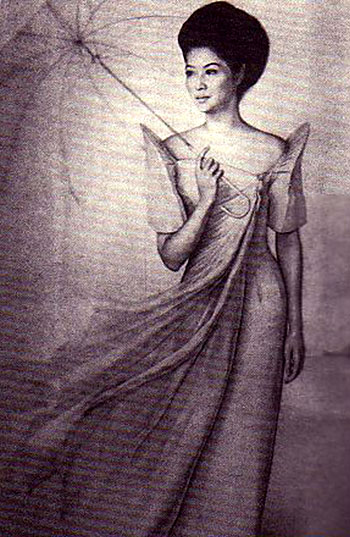
Ternos - A Filipina's Treasure

The Terno is the national attire for women in the Philippines. It has been called a masterpiece, a classic, a national treasure. Terno, from the Spanish word meaning “to match”. The Filipino Terno alludes to the matching of blouse and skirt, joined at the waist to form a one-piece creation, with both bodice and skirt made of the same material. It is known for its inventive feature: its upright sleeve, flat against the shoulders like clipped butterfly wings.

The national dress didn’t start the way it looks today. In fact, the elegant Terno was the coming together of the innovations of many. It is the product of craft and skill in design of the Filipina. It reveals the mind of the Filipina as she related to herself, to her society, to her times, and to the world. It speaks volumes of a heritage that spanned decades of multi-cultural influences and raw patriotism. The Terno is not just a style it is a legacy. The terno exude pride and dignity of Filipino women.

Source: Published in Nancy's Fashion and Jewelry


Former First Lady Imelda Romualdez Marcos  popularized the terno, the Philippine national dress for women with butterfly sleeves, when she became First Lady. 

In the recent celebration of the State of the Nation Address (SONA) last July, 2012, after more than a year in the  office of presidency of Aquino, a lot of women attendees wore the ternos in different colors and designs showing that the ternos are still in great demand among our women elite. (Source of images: Inquirer).  A fashion show of some of our Filipina ternos has been shared in You Tube as follows:


But younger  women have developed a new trend for casual wear of ternos.


Source of Images: A wander girl

Tuesday, July 26, 2011

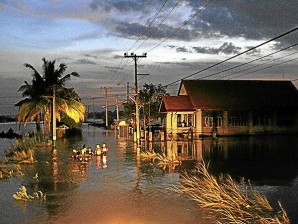
How Filipinos Live With Heavy Rain

NOEL CELIS (AFP) | 26-07-2011
Source:  El País

According to today's Madrid press,  typhoon Nock-ten (Juaning) caused 9 fatalities and 11 are missing  in the City of San Juan, east of Manila.

And this is how Filipinos cope with typhoons as disastrous as they may happen to be.


Filipinos belong to a strong race and they have a predisposition to cope with whatever obstacle that they may encounter. The Filipinos are gifted with the spirit of the will to survive. While  they  take advantage of whatever opportunity that may arise even in a tragic situation, they keep hoping and praying  that when they wake up in the morning  the next day the sun will shine again to bring a smiley day. Hoping.... and praying....

Source of Images:  El País, Malaysian Insider, Terra Noticias - July 26, 2011

Monday, July 25, 2011

A Culture That Reflects Spanish Culture

A Culture That Reflects Other Cultures
With the Spaniards having reigned in the Philippines for more than 3 centuries, it is normal to see some of the Spanish influences reflected in our Filipino culture.  To name some, there are common Spanish words that have been incorporated in our local language like:

Whenever we ride jeepneys (which are the national public mode of transport in the Philippines) and we want to get off the said vehicle, we always say the word "para,"  the Spanish word for "stop."

Similarly, we also commonly use the words mesa, "table" or misa "mass",  Dios "God", etc....


A lot of houses are also  in congruence with the Spanish architectural styles specially shown in some of our Filipino luxury houses.


Source of images:  Google

And yet, the Filipino culture is unique in its hospitality. "For Filipinos, serving other people the best of what they have leave them an honor and a promise of true friendship. Arriving at your host’s  house during mealtime may be awkward but if its in a Filipino house, you will be asked to sit down and share with what they have on the table. Because eating alone without asking others according to Filipino customs is considered rude. A form of hospitality that comes truly from the heart like how the country made its image as the land of true smiling people. Considering the struggling economy, political confusions and the rising poverty in the country, anyone will be surprised seeing how Filipinos handle such situations. It is like taking everything from them but not their love of joking. Joking and laughing at everything perhaps give them relief and make them see things more positively".

Source of quoted text:  Camperspoint