Showing posts with label Day Events. Show all posts

Monday, November 7, 2011

Mimic Show of Ennio Marchetto


Today, we went to see a mimic show in a theater in Madrid.

This is a one man show that has triumphed in more than 70 countries, and we had the chance to see how Ennio Marchetto, 51, an Italian from Venice transformed himself  changing rapidly to do his memorable interpretations of some famous international and local personalities such as: Mona Lisa, Lady Gaga, Marilyn Monroe, Celine Dion, Abba, Barbra Streisand, Madonna, Dolly Parton, Amy Winehouse, Tina Turner, Elvis, Freddie Mercury, Beyonce Knowles, Queens, Liza Minelli,  Julio Iglesias, Lola Flores, Rafael, Alaska, Miguel Bosé, etc.


Ennio's show was inspired by the animated cartoons of Disney which he used to watch when he was a boy, with the modern coreography of Pina Bausch and the carnival air of his natal city of Venice.

Ennio's show  along with an unbeatable sound track, made him gain numerous international awards and made it a global phenomenon. 

The quickness of his movements as he transformed from one personality to the other sometimes wearing three layers of extravagant clothes and masks, created from origami, immitating different personalities, was a funny thing to watch as he danced and interpreted some all times favorite songs.

It was different from all the other shows that we have seen before and the four of us who watched Ennio, along with many others of the audience, were all delighted and entertained with the show.  Too bad we were not allowed to take pictures.

Tuesday, October 4, 2011

October Winds


October has just started and although in Madrid it feels more like summer in most hours of the day, autumn slowly gets to invade the early mornings and evenings with its soft, cool breeze and short days creep while sunsets come earlier but linger less.

I love Autumn just like I love Spring for the changing colors of the leaves which in certain trees are much more visible just like in the maple trees and gingko which turn into different colors before they fall on the ground or as blown away by the mere greeting of the gentle Wind.

Autumn, it seems, tries to get us ready for the coming of winter, to be able to finish the tasks left over from the previous season that was left undone due to the warm heat of summer, stressful by itself, and discouraging any attempt to do anything at all but leisure. Autumn is a nice time to go for a walk and observe the changing colors of the leaves, and if you are lucky you can also see some of the few birds that lingered behind chirping as if looking for the rest of the flock to be able to unite with them.

Similarly, as the earth goes through seasons, so does a family in the course of time tangle its way through seasons.  Marriage, falling in love, and the birth of  children are times of renewal that can relate with  Spring.  The blessing of a peaceful and  pleasant period that some families are lucky to experience, give the feeling of Summer that does not seem to end.  As we grow while our children do too, somehow our leaves begin to take a different shade.  That stage can be called Autumn.  We might think that this seems like dying, but like the trees, this is only a sign of a new phase of life.  The times of crises which can be emotional, economic or otherwise are times for the family to stay close together, help each other out and endure what are sometimes the frigid winds of change. This period is akin to Winter.  Life is full of seasons and changes but with the  support of friends and family, we get by to brace ourselves against whatever demands that may come up with  the change of season.  In contrast with the earth season, the  family  season can become one big chain of love, hope and care. I hope we find beauty in every season.

Sunday, October 2, 2011

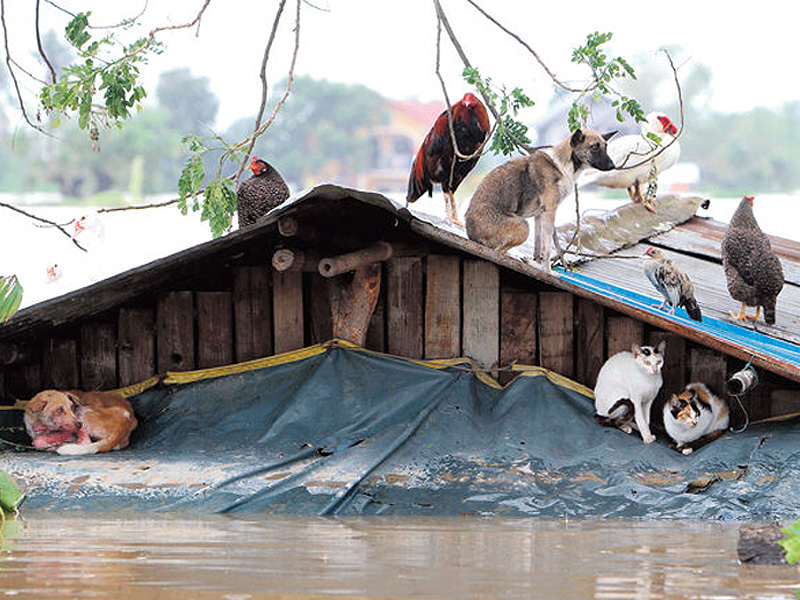
Like Noah's Ark


Animals follow their instincts to survive
The rooftop serves as veritable Noah’s Ark of a few animals—cats, dogs, chickens, ducks and a pigeon—after the owners abandoned the submerged house in Gugo village, Calumpit, Bulacan. Unfortunately, rescue workers could only evacuate humans. LYN RILLON…
Source:  Inquirer.net

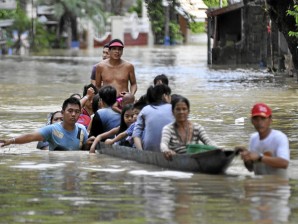
While people are being transported by boat.
Moving away from typhoon "Quiel"
From June to December every year, Filipinos have to brace themselves against the ruthless typhoons that affect several regions in the Philippines. Although the government has become aware of the importance of avoiding loss of lives through evacuation of endangered areas, the citizens are hesitant to abide mainly because of  the fear of looting of what can be their only possessions left behind by the aggressive trail of the typhoons.  Likewise amidst the warning of being  swept by the passing of the typhoon, some people think that the government is exaggerating and that they would be better off holding tight to each other and not move away.  Neither would fishermen allow themselves to lay aside their daily tasks of going into the sea to lose their earnings for the day.

But people learn eventually, even if through the hard way.

Thursday, July 21, 2011

Summer Baths

Bathing in the river

HAZIR REKA (REUTERS) | 19-07-2011
Two Albanian kids while they take a rest under the sun over a rock in the Beli Drim river, near  Djakovia, 80 kms. from the  Pristina capital.
Source:  El País
Bathing in algae
AFP | 18-07-2011
The bank of algae that invaded the Qingdao coasts, east of China, have not impeded bathers to go to the beach and enjoy a typical summer Sunday.
Source:  El País

Bathing in a pool
The world's most crowded swimming pool, located in Tokyo, Japan summerland. In  summer, there are too many people in the pool that there simply is no water to draw from. Call this socializing!
Source:  Hub Pages

Bathing in a Fountain
ULY MARTÍN | 26-06-2011
Due to the high temperature, some teens refresh themselves in the fountain of  Templo de Debod in Madrid.
Source:  El País
I am happy with my bath tub and my shower!

Thursday, June 30, 2011

Independence Day In Madrid

Last Sunday, Filipinos in Madrid gathered together for a holiday celebration, with the theme "Kalayaan, paninindigan ng bayan" (The People will stand up for their freedom). As in previous years, there were a lot of stands filled with different kinds of typical Filipino food.


In Madrid, contrary to the States,  this is the only occasion of the year when we have a choice among  varieties of our food displayed and available for purchase which you either eat there on set tables  or to take away.  Ron and me chose to do both.  Actually, we only have one decent Filipino Restaurant in Madrid, which is "Sulu Restaurant" where Nick started to work when he first arrived in Madrid.

This year, I took only one picture of the event (Ron added some more),  but I had some pictures from last year with similar display of food items.   Watch the food slide show  although sad to say,  most of the food were prepared for take away and are not visible inside the plastic packaging and the huge covered containers although for sanitary reasons, better.   Note that there were free tapas and we were lucky we were invited to have as much as we wanted.  Take note also of the moderate prices. Lucky because we were among the first to eat and enjoy the food although we missed the program of activities because it was too hot  so we decided to leave quickly.

Tuesday, June 28, 2011

Boogie Colors Terrace


Thursday, June 9, 2011

Unlike Them


Workers sleep along the highway under mosquito nets in Islamabad, Pakistan.  Muhammed Muheisen/ AP


While  a fisherman takes his nap as he dries and salts fish in Jakarta, Indonesia.  Irwin Fedriansyah/ AP

Unlike them, we sleep on  comfortable beds and  yet sometimes we complain that  we cannot sleep.  Instead of counting sheep, let us think of the less fortunate ones who sleep placidly along highways and salted fishes.  

El Mundo, June 8, 2011

Friday, June 3, 2011

Typically Spanish

With the temperature on the rise, Spain in its bars and cafés has started  to serve tapas, which are small portions of food such as omelette, ham, cheese and olives  and drink. Several tapas oftentimes constitute a meal.


And the practice of going out for a drink, called tapeo is part of the Spanish social life.  It is common to have people eating in sidewalk cafés or in much  wider spaces outside.


Such a typical Spanish scene for the season!

Pictures published in:
El Mundo

June 2, 2011

Thursday, June 2, 2011

Kayak Mel&Andy


Here's Andy with our double kayak.  He likes to use it for fishing while I like to paddle around the islands in Poole Harbour.  It's Good Fun!

Sunday, May 29, 2011

Fiestas in May

In Spain as well as in the Philippines, May is a festive month and  in the town where I live, our fiestas started with fireworks last Friday.  We have all sorts of rides and also some small shops around.

Traditionally, fiestas were held to honor a saint, but nowadays, they seem to be observed  as an occasion  for the teens to gather and drink leaving their  signatures in  trash and others that cannot be  mentioned.
 
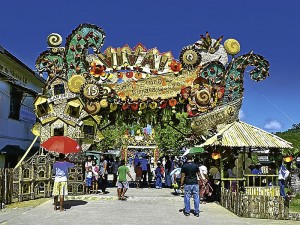
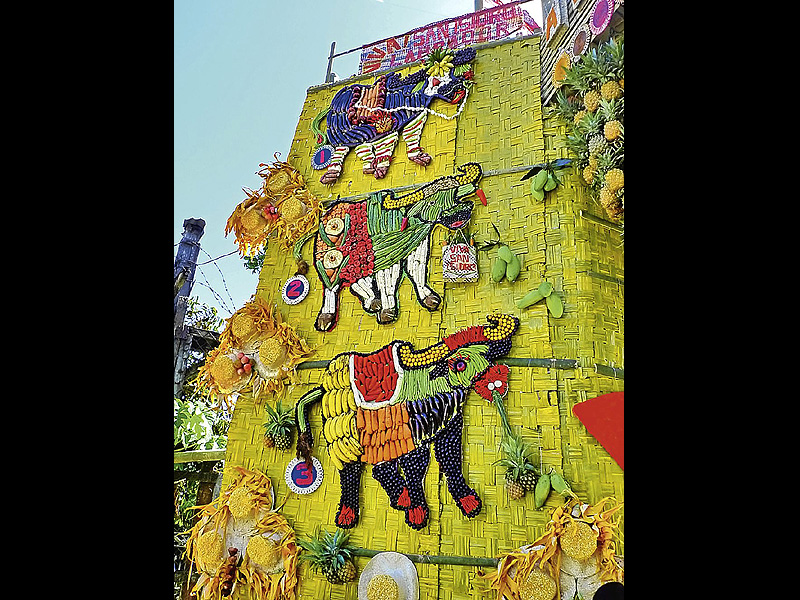
But in the Philippines, in Gumaca,  one of the oldest towns in the country, the  Baluarte Festival, probably one of the merriest and grandest fiestas in honor of St. Isidore, the people celebrate to show their gratitude for the bounty of the land by building big bamboo arches called "baluarte" a bastion decorated  with chandeliers made of bamboo, to display  their own harvests and other embellishments, called araña.

This is the araña

Display in  Baluarte

Embellishments

The festivities start Saturday night with the “Gimikan” and “Yubakan,” a competition among barangays on the best yubak and street dance. A traditional Gumaca delicacy, yubak is made of cassava or a certain type of banana "saba" mashed with coconut, peanut butter, sugar and milk.  Guests move from one baluarte to another to taste the yubak and see the youth perform their dance moves, with everything including the chairs and sound system mobile so the party hops from one baluarte to another. 

And contrary to Spain,  amid all the festivities,  among the people of Gumaca  their genuine effort to honor their patron saint, as well as their pride in the harvest and bounty of their land still remain.


Excerpts from the report by:


Saturday, May 28, 2011

Parque Europa


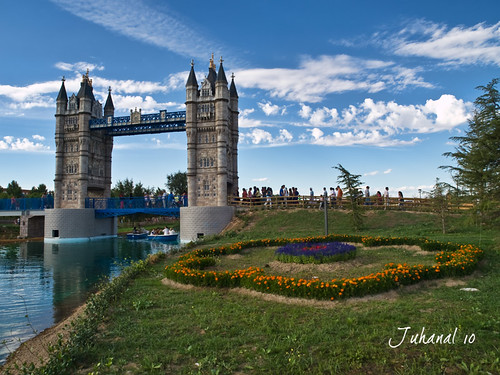
Parque Europa  lodges one of  the biggest areas of greens and recreation in   Torrejon de Ardoz. It extends over a surface of 233,000 m2, and has the reproduction of the most emblematic monuments of the main European cities as well as   different forms of recreation (with picnic grounds)  and multi-adventure areas, including small parks for dogs dividing the area between small ones and big ones, and best of all, it has a cybernetics fountain which is unique in all Europe, where every week-end at 11:00 pm they present a show of water, light and sound.

Last night, Ron and me marvelled in watching the show, which is free and so is the entrance to the park.  It is a place that the residents of Torrejon de Ardoz can be proud of and  is an excellent achievement of  their city mayor, Pedro Roldan who in the latest elections renewed his post with majority votes.

The 17 monuments that can be seen in the park are as follows:


Muro de Berlín-                     Wall of Berlin 
Puerta de Brandenburgo-  Gate of Berlin
Teatro Griego-                       Greek theater
Plaza de España  -               Spanish Plaza
La Sirenita-                             Mermaid in Copenhagen
Barco Vikingo-                      Viking Boat from Sweden
Fontana de Trevi-                 Italian Fountain of Trevi
David de Miguel Ángel-       Florence David of Michelangelo
Torre Eiffel-                            Eiffel Tower in France
Manneken Pis-                      Little Man Pee of Brussels
Plaza de Europa-                  European Plaza
Atomium-                                Expo 1958 Brussels
Puerta de Alcalá-                  Gate Entrance in Madrid
Torre de Belém-                    Belem Tower Portugal
Puente de Londres-             London Tower, UK
Puente de Van Gogh-          Bridge of Van Gogh
(First Painting) France
Molinos Holandeses-          Holland's windmills


It was a gratifying experience and I promise to visit it again during the day.

Friday, May 27, 2011

Not without my dog


This is an advertisement published  in 1939 for  a British  railway to encourage pet  owners to  travel by train  accompanied by their pets.  However after several years, travelling in Spain with your best friend continues to be a problem.


All in all including rural houses and campings, the number of    establishments now add up to 8,200 according to Maria Azcargota, manager of  Affinity Pet Care,   whose main aim is to promote the integration of animals in society. However, she claims that Spain is still far behind France or Germany.

 
The first Travel Guide with  Animals for Company, was published with the idea that dogs were abandoned in summer when  their owners had to go on vacation.  But then statistics showed that the most common reasons were the lack of interest for the puppy  or economic and behavioral  problems.


As obtained from the  same source, hotels are not just admitting them, but more so they are providing more services which include walking them, veterinaries or "dogsitters" after all, they charge  an average amount between 10 to 30 Euros per day for the stay of the dog.


These days, hotels and restaurants are now offering chairs specially designed for dogs, non-alcoholic beer that tastes like bone, or beds with canopy.

Source: Blog of Patricia Gosálvez in El País, May 27, 2011.


Saturday, May 21, 2011

Watch a bullfight in Madrid

Bullfight in Madrid  begins in March and ends in October.  Although Spain is famous for its bullfighting, I have never seen one since I detest what some people think is a way of entertainment.  But what does a BULLFIGHT consist of??

In a bullfight, there are usually three bullfighters against 2 bulls each.  And their turns are determined according to their date of "alternativa" (similar to a degree).  It starts with the paseillo, where all those that perform directly take a parade before the public.  This consists of the "alguacillos" mounted on horses to cross the plaza to address themselves to the Presidency and symbolically solicit the key to the "puerta de los toriles" (where the bulls are kept).  Behind are the three bullfighters followed by the members of their team of three "banderilleros" (one who puts a stick in the bull's neck) and two  picks (one on horseback with a pointed pole of 2 meters whose purpose is to prick the animal so it cannot raise its head when attacking the bullfighter).  At the end of the cortege are the so called "mozos" and "mulas de arrastres" (who are in charge, once the bull is dead, to remove it from the plaza).

Once the key has been delivered and the cortege has left, the door keeping the bull is then opened.  As the bull enters the plaza,  the bullfight begins.  The bullfighter will maintain a dialogue with the bull and at the same time fight against the animal to try to win it.

The bullfight is divided in three parts called "tercios" highlighted with the sound of a clarion.  In the first part, the bullfighter uses his cape.  Then the sound of a clarion signals the two picks to join, situating each one of them in the extreme of the plaza, but merely to bring that "luck".
 
In the second part, is what they call "suerte de banderillas" wherein the "banderilleros" (one who puts a stick in the bull's neck) inserts to the bull's neck with  three pairs of "banderillas" (a barbed dart).


Then, the bullfighter ejecutes the "suerte suprema", wherein he will fight with the crutch instead of the cape, to finally, take the sword and kill the  bull.  This is the most difficult part of his task, since at these moments he should be able to get the bull to attack him, and just in the middle of this attack, he should find the moment to plunge the sword in the heart of the bull and kill it.  This is the part when the bullfighter openly exposes his body before the bull.  It is a fight that is considered to be a live and ephemeral art.  In a matter of seconds, he should concentrate in hitting without fail a concrete point of the bull while it is in movement.

If the series of passes, as well as having killed the bull with one sword thrust, have transmitted to the public all the cumulus of  positive sensations, the public awards him.  The trophys are one or two ears of the bull that was killed, and as a maximum, the tail.

The public solicits the trophies from the president by moving  symbolically their handkerchief, while the president of the plaza is the one who makes the final  decision,  whether to accede or not to the public petition.  The highest honor to a bullfighter after an extraordinary performance is to leave the plaza lifted on the shoulders by a multitude.

The Associations for the protection of animals have tried to abolish this kind of spectacle but to no avail until now since bullfighting has become deeply rooted in  Spanish culture.


TODO SOBRE ESPAÑA © 1996-2011 INTERNET Red 2000, S.L. - ESPAÑA